Drug Driving Lawyer Melbourne
A drug-driving charge can place your licence, employment and independence at risk. Victorian law covers several different offences, including driving with a prescribed illicit drug present, driving while impaired and refusing a drug test.
Drug driving first offence Vic
If the matter goes to court, the court may impose a fine of up to 12 penalty units. The ordinary minimum licence disqualification is six months.
Driving while impaired is a different and more serious offence. A first offence carries a minimum 12-month disqualification. A related offence of DUI carries 24-months off the road. Pleading to the right charge can have a significant impact on your licence loss.
There is no general work licence in Victoria. A Magistrate cannot reduce a mandatory minimum disqualification period, but a well-structured plea which includes information about your need for a licence, including work and personal reasons, is often influential on whether a Magistrate goes beyond the minimum.
Melbourne’s Leading Drug Driving Lawyer
If you’re facing drug driving charges in Melbourne, working with an experienced drug driving solicitor can increase your chances of receiving leniency when determining your sentence.
With 15 years in the Victoria police force, moving into traffic law as a criminal defence barrister in 2015, I have extensive knowledge and understanding of the law and court proceedings around drug driving offences.
As your representative, I will provide the support and advice required to achieve the most positive outcome for your specific case.
Steps To Take After Being Caught Drug Driving
If you have been caught driving under the influence of drugs, as described in section 3 of the Road Safety Act 1986, police will ask for a saliva sample for testing. A failed test will lead to questioning by the police - I recommend seeking advice before answering any of these questions.
You will be issued either an Infringement (financial penalty) or a Release on Summons (charges to be determined at court). Depending on the circumstances of your charge, I will negotiate a withdrawal of charges or alternative charges that are in your best interest.
Book Your Consultation
Driving with a Prescribed Illicit Drug Present
- Section 49 (1)(bb) relates to matters where a driver is accused of driving or being in charge of a motor vehicle while having any detectable amounts of a prescribed illicit drug present.
- Section 49 (1)(h) relates to matters where a prescribed drug is present in an oral sample within 3 hours of driving or operating a motor vehicle.
- Section 49 (1)(i) relates to matters where a prescribed drug is present in a blood sample within 3 hours of driving or operating a motor vehicle.
The prescribed concentration of drugs
Offences specified under sections 49(1)(bb), 49(1)(h), and 49(1)(i) of the Road Safety Act 1986 refer to exceeding the prescribed concentration of drugs. That concentration is defined in section 3(1) to be any concentration of a prescribed illicit drug.
Prescribed Illicit Drugs Include:
- THC (the active component in cannabis)
- Methamphetamine (commonly referred to as ice or speed)
- MDMA (commonly referred to as ecstasy)
Penalties for Driving with a Prescribed Illicit Drug Present
Penalties for driving with a prescribed illicit drug in your system above the prescribed concentration carry maximum penalties of;
First offence; maximum fine of 12 penalty units
Second offence; maximum fine of 60 penalty units
Subsequent offences; maximum fine of 120 penalty units
If you are found guilty of driving with a prescribed illicit drug in your system above the prescribed concentration, the court will issue mandatory licence disqualification periods of;
First offence; minimum mandatory period of 6 months licence disqualification
Subsequent offences; minimum mandatory period of 12 months licence disqualification
Driving under the influence (DUI)
To be successful, the prosecution must prove the following to charge a DUI:
- That you are correctly identified as the offender;
- You were driving / in charge of a motor vehicle;
- You had consumed alcohol or other drugs; and
Because of the alcohol or drug consumption, you were incapable of having proper control of a motor vehicle.
Penalties for DUI
• For a first offence this carries a fine up to 25 penalty units or prison for up to 3 months
• For a second offence a fine up to 120 penalty units or up to 12 months prison.
• For any other subsequent offence, a fine up to 180 penalty units or up to 18 month prison.
Note that the value of a penalty unit is updated each year but is valued at $197.59 for the period from 1 July 2024 to 30 June 2025
Mandatory Loss of Licence
DUI offences carry minimum mandatory licence disqualification periods of 2 years for a first offence and 4 years for a subsequent offence. While the court can increase the period of disqualification it can not reduce this period even if you have compelling and exceptional circumstances.
Drive whilst impaired by a Drug
To be successful the prosecution must prove the following in relation to this charge:
- That you are correctly identified as the offender
- You were driving / in charge of a motor vehicle
- One or more drugs were present in your body at the time of driving / being in charge.
- You were impaired by a drug.
Penalties for driving whilst impaired a drug
- For a first offence a fine of up to 12 penalty units
- For a second offence a fine of up to 120 penalty units or imprisonment for up to 12 months
- For a subsequent offence, a fine up to 180 penalty units or imprisonment up to 18 months.
Mandatory Loss of Licence
Driving while impaired carries a minimum mandatory licence loss of 12 months for a first offence and 2 years for a subsequent offence.
Advantage of pleading to driving whilst impaired pursuant to section 49(1)(ba) over DUI under 49(1)(a)
If you have no prior history of offending there is a clear advantage in that the court is not able to imprison you for an offence pursuant to section 49(1)(ba). The mandatory licence loss is half of that contained in a DUI charge. A successful negotiation with police in respect to this charge can have a profound impact on your sentence and time off the road.
Defence in relation to prescription drugs
There is a defence if you are charged on the basis of being impaired by a prescription drug so long as it is taken in accordance with the prescription and that you did not know and could not reasonably have known the drugs would impair your driving.
REFUSAL OFFENCES
Refusing Oral Fluid Drug Testing
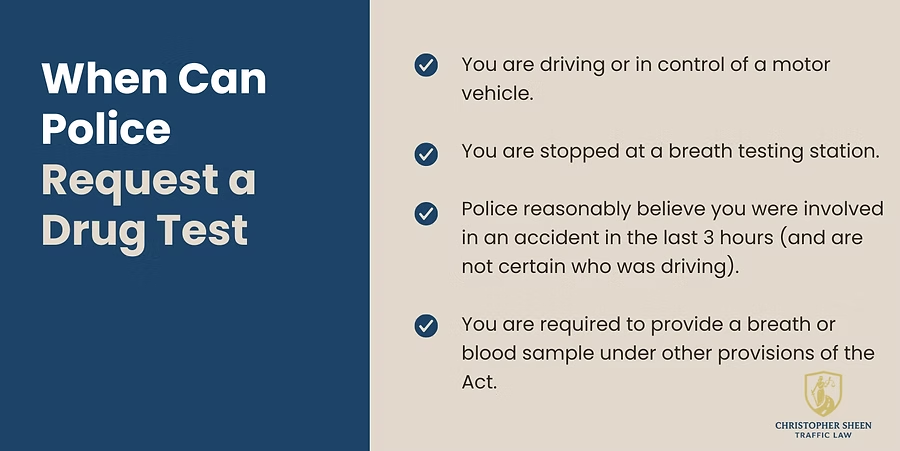
Refusing oral fluid testing under section S49(1)(eb) typically relates to matters where a you are stopped for testing however, it is important to note that pursuant section 55D(1), a police officer may request oral fluid testing when;
i. You are found driving /in control of a motor vehicle; or
ii. You are driving a motor vehicle and required to stop and remain stopped at a preliminary breath testing station; or
iii. Police reasonably believe that you were driving / in charge of a motor vehicle which was involved in an accident within the last 3 hours;
iv. Police reasonably believe that you were an occupant in a motor vehicle involved in an accident within the last three hours, in circumstances where they have not established who was driving
Penalties for Refusing Oral Fluid Drug Testing
First offence; maximum fine of 12 penalty units
Second offence; maximum fine of 60 penalty units
Subsequent offences; a fine of 120 penalty units
Drivers found guilty of refusing oral drug testing under section S49(1)(eb) of the Road Safety Act 1986 face mandatory licence disqualification periods of;
First offence; 2-year licence disqualification
Subsequent offences; 4-year licence disqualification
Refuse to undergo Assessment Test for Drug Impairment
To be successful the prosecution must demonstrate:
- You were the driver:
- You were:
- Found driving /in control of a motor vehicle; or
- Driving a motor vehicle and required to stop and remain stopped at a preliminary breath testing station; or
- Police reasonably believe that you were driving / in charge of a motor vehicle which was involved in an accident within the last 3 hours;
- Police reasonably believe that you were an occupant in a motor vehicle involved in an accident within the last three hours, in circumstances where they have not established who was driving; or
- Required to undergo a preliminary breath test pursuant to section 53; or
- Required to provide a sample of breath pursuant to section 55; or
- Required to provide a blood sample in accordance with section 55(9A); and
- You were required to undergo an assessment for drug impairment in accordance with section 55A; and
- The requirement was made within 3 hours of your driving / being in charge/ being an occupant.
- You refused to comply with the requirement or any other requirement pursuant to section 55A(1)
Refuse Blood / Urine Test
The prosecution must demonstrate:
1. You were the driver:
2. You were:
- found driving /in control of a motor vehicle; or
- driving a motor vehicle and required to stop and remain stopped at a preliminary breath testing station; or
- Police reasonably believe that you were driving / in charge of a motor vehicle which was involved in an accident within the last 3 hours;
- Police reasonably believe that you were an occupant in a motor vehicle involved in an accident within the last three hours, in circumstances where they have not established who was driving; or
- Required to undergo a preliminary breath test pursuant to section 53; or
- Required to provide a sample of breath pursuant to section 55; or
- Required to provide a blood sample in accordance with section 55(9A); and
3. You were required to undergo an assessment for drug impairment in accordance with section 55A; and
4. The assessment, in the opinion of the officer, indicated you may be impaired by a drug(s); and
5. The police officer required you to:
- Allow a medical practitioner or approved health professional as nominated by the officer to take a sample of your blood for analysis; and/or
- Provide a registered medical practitioner / approved health professional as nominated by the officer with a sample of urine for analysis; and
6. For the purpose of providing the sample you were required to:
- Accompany the officer to a place where the sample was to be taken; or
- Remain at the place where the sample was to be taken; or
- Remain at the place for 3 hours following the driving/ being in charge; or
- Allow a sample of blood or urine to be taken for analysis; and
You refused to remain or allow the sample to be taken as required
Penalties for Refusing Blood or Urine Drug Testing
Drivers found guilty of refusal offences pursuant to section S49(1)(ca) or S49(1)(ea) of the Road Safety Act 1986 face penalties of:
First offence; maximum fine of 12 penalty units
Second offence; maximum fine of 120 penalty units or imprisonment for up to 12 months
Subsequent offences; a fine of 180 penalty units or up to 18 months imprisonment
Drivers found guilty of refusing oral drug testing under section S49(1)(ca) or (ea) of the Road Safety Act 1986 face mandatory licence disqualification periods of;
First offence; 2-year licence disqualification
Subsequent offences; 4-year licence disqualification
Legal Representation for Drug Driving Offences in Melbourne
Many considerations go into drug driving charges in Melbourne - it is not a straightforward process. I am an experienced traffic offence lawyer in Victoria, specialising in matters such as drug driving, drunk driving, dangerous & careless driving, and driving while suspended offences - I understand the ins and outs of the law and court proceedings for traffic offences.
I can help negotiate the best possible outcome for your charges, including reducing fines and licence suspension. Drug driving is a serious offence, and I appreciate how stressful and confusing the process can be. I will provide guidance and help you understand what is happening throughout the offence.
How can a drug driving lawyer help?
A drug driving lawyer in Melbourne can examine whether police followed the correct testing procedures, whether the evidence supports the charge and whether the prosecution can prove every element of the offence.
Chris Sheen Barrister has 15 years’ experience with Victoria Police and over a decade of experience as a defence lawyer and barrister. His police experience included traffic duties, serious collision investigations and prosecuting traffic offences. He now acts solely for accused people.
Chris accepts suitable direct briefs and personally handles each accepted case from beginning to end. Fixed fees are disclosed in advance and paid by instalments for each court date.
How it Works


Frequently Asked Questions
What drugs do the police roadside test for in Victoria?
In Victoria, roadside (oral) drug testing can detect the following illicit drugs;
THC (the active component in cannabis)
Methamphetamine (commonly referred to as ice or speed)
MDMA (commonly referred to as ecstasy)
Roadside drug testing in Victoria is not intended to detect the presence of prescription or over-the-counter drugs.
How long can drugs be detected in the system?
There is no standard answer to this question. Just like alcohol, individual circumstances such as gender, weight, age, and other factors will influence how long illicit drugs can be detected in the system.
Variables including the quantity of the drug that is taken, and the known or unknown chemical composition of the drug will also have a bearing on how long it remains present and detectable.
The police did not explain the consequences of refusing to undergo the oral fluid test. Is that a defence?
No, although routinely police do advise of the consequences of a refusal they are not required by law to do so: DPP v Vaa (2004) 42 MCR 511.
There was no device for the oral fluid present when the request to undergo the test was made. Is this a defence?
No, there is no requirement that the device for testing be present at the time of the request, there is no requirement that a person authorised to carry out the test be present at the time and no requirement that a medical practitioner/ approved health practitioner be present at the time a blood test was requested. If you refuse you can not rely on these factors as a defence.
Is the penalty higher if I test positive to both alcohol and drugs?
Yes, section 49(1)(j) of the Road Safety Act contains a specific offence relating to the combination of alcohol and drugs. For a first offence you can be fined up to 30 penalty units. A second offence and subsequent offences can result in heavy fines and jail time. Schedule 1AB contains a table of how long your licence based on your blood alcohol content. The periods of disqualification are much higher than they would be without the combination of alcohol and drugs.
Can you go to jail for drug driving offences?
For first drug driving offences, charges are generally a fine, unless the first offence is Driving under the Influence per s49(1)(a) Road Safety Act. The maximum imprisonment time for this offence is 3 months of 25 Penalty Units. Drug driving offences where a jail sentence is more likely are if you have been caught for drug driving previously.
What happens for a first drug-driving offence?
An eligible first offence may result in a fine of three penalty units, a six-month licence suspension and a compulsory behaviour change program. If determined in court, the maximum fine is 12 penalty units and the ordinary minimum disqualification is six months.
Do police have to prove that the drug affected my driving?
Police must prove that a prescribed illicit drug was present, but do not need to establish impairment. Driving while impaired and driving under the influence are separate offences requiring different evidence.
What are the consequences of refusing a drug test in Vic?
Refusal is a separate and serious offence. A first refusal to provide an oral-fluid sample can result in a fine of up to 12 penalty units and a minimum two-year licence disqualification. A second offence within 10 years results in a mandatory 4 year licence disqualification. The lawfulness of the request and the circumstances of the alleged refusal should be examined.
Is medicinal cannabis a defence to drug driving?
No. A lawful prescription does not provide a defence to driving with THC present. However, for offences committed on or after 1 March 2025, a court may have discretion not to cancel or disqualify the driver where the THC resulted from lawfully prescribed medicinal cannabis. It is essential to prepare a plea thoroughly when these circumstances apply.
Can I get a work licence?
No. Victoria does not have a general work-licence system for drug-driving offences. Employment hardship can be explained to the court, but it does not permit a Magistrate to impose a disqualification less than the mandatory minimum.
Possible Defences
There are various defences available and all will depend on the specific case. Some defences include:
- Time limit issues
- Disputing identity
- The refusal was not conscious and voluntary
- Poorly drafted charges in matters where the statute of limitations have expired. Note that this will be limited according to DPP v Kypri [2011] VSCA 257.
- Defence of substantial character in relation to refusing to furnish a sample of breath. Note that this does not apply to charges of refusing to accompany police to a place for testing or refusing to remain at such a place.
- The requirement to accompany police for an oral fluid test is not objectively reasonable. For example asking you to walk kilometres away would not be reasonable in accordance with DPP v Mastwyk.
- The requirement to remain does not contain sufficient information in accordance with DPP v Rukandin [2011] VSCA 276.
- The request to accompany does not properly state the purpose of the requirement and circumstances justifying it: Mitchell v DPP (2004) 8 VR 192.
- Police do not have the power to request you to undertake the test relevant to the charge for example requesting an oral fluid test in circumstances where you are not found driving and no collision has occurred.
- Even if no defence is available, negotiations with police in relation to which charges are to proceed can have a substantial impact on the length of any licence loss and penalty.
Speak to a drug driving lawyer in Melbourne
If you have been charged with a drug-driving offence, contact Chris Sheen, a drug driving lawyer, for advice about the evidence, possible defences, licence consequences and court representation.
Get in touch today
Simply fill out the form below with your contact details to arrange an initial consultation.
To provide the most efficient and cost-effective traffic law service, consultations are done through Zoom or Microsoft teams. Meetings may be arranged on site at Owen Dixon East Chambers Melbourne for an additional fee.